How Many Times Per Week Should We Workout?
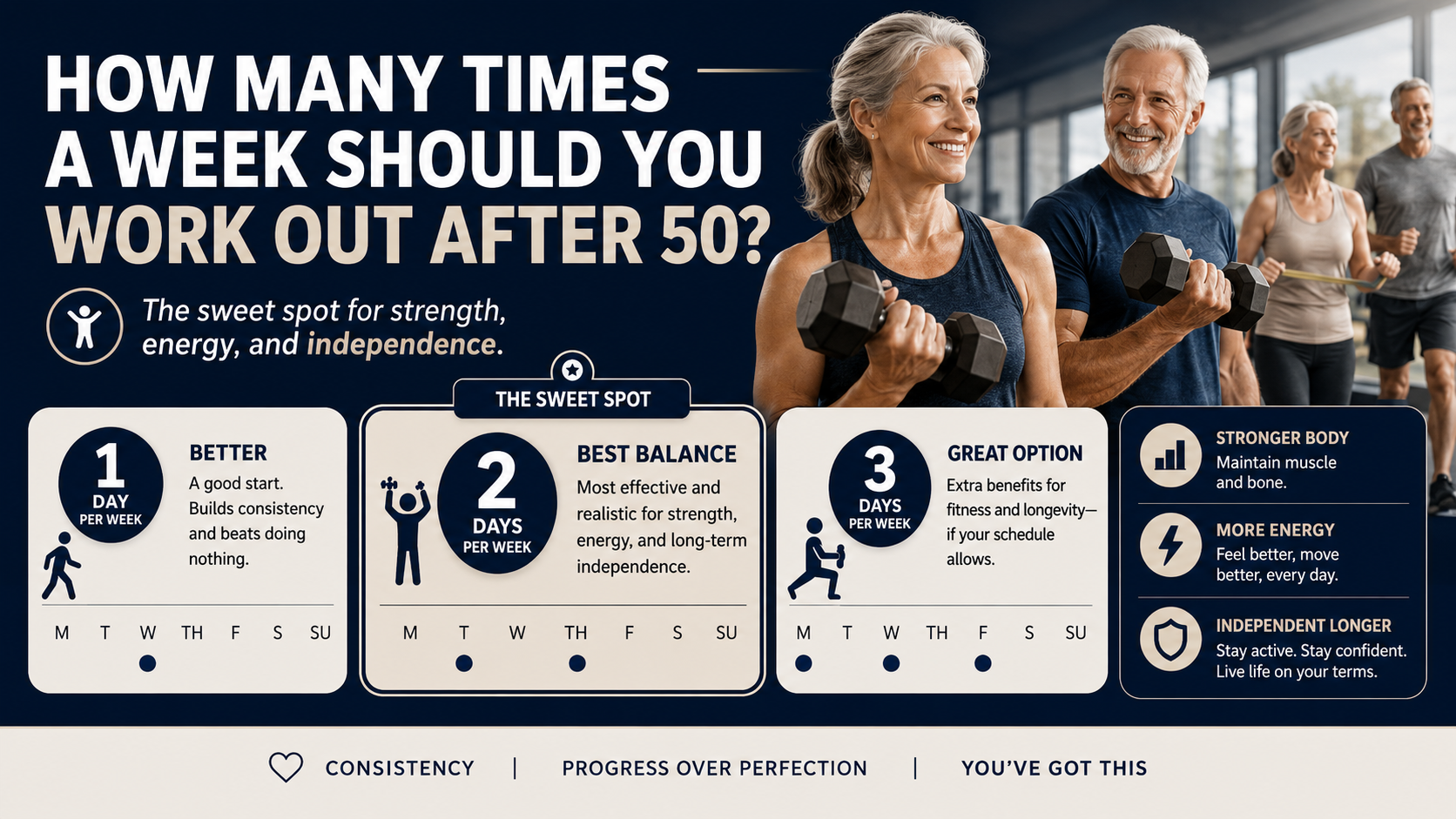
Short answer: two to three times a week. That's it. That's the whole formula — and if you've been told you need to live in a gym to see results after 50, this article is going to be a relief.
I'm John Thomas, owner of STRONG in Folsom and Shingle Springs, CA. I'm NSCA-certified, I have a tactical strength and conditioning background from my time in the military, and I've spent over ten years building strength programs specifically for adults 50 and up. I've also had a hip replacement, so I'm not just coaching this from a textbook — I've trained through it myself.
Here's everything that goes into that "two to three times a week" answer, and why it's not a compromise — it's the actual prescription.
Why Two to Three Days Is the Sweet Spot (Not a Starting Point)
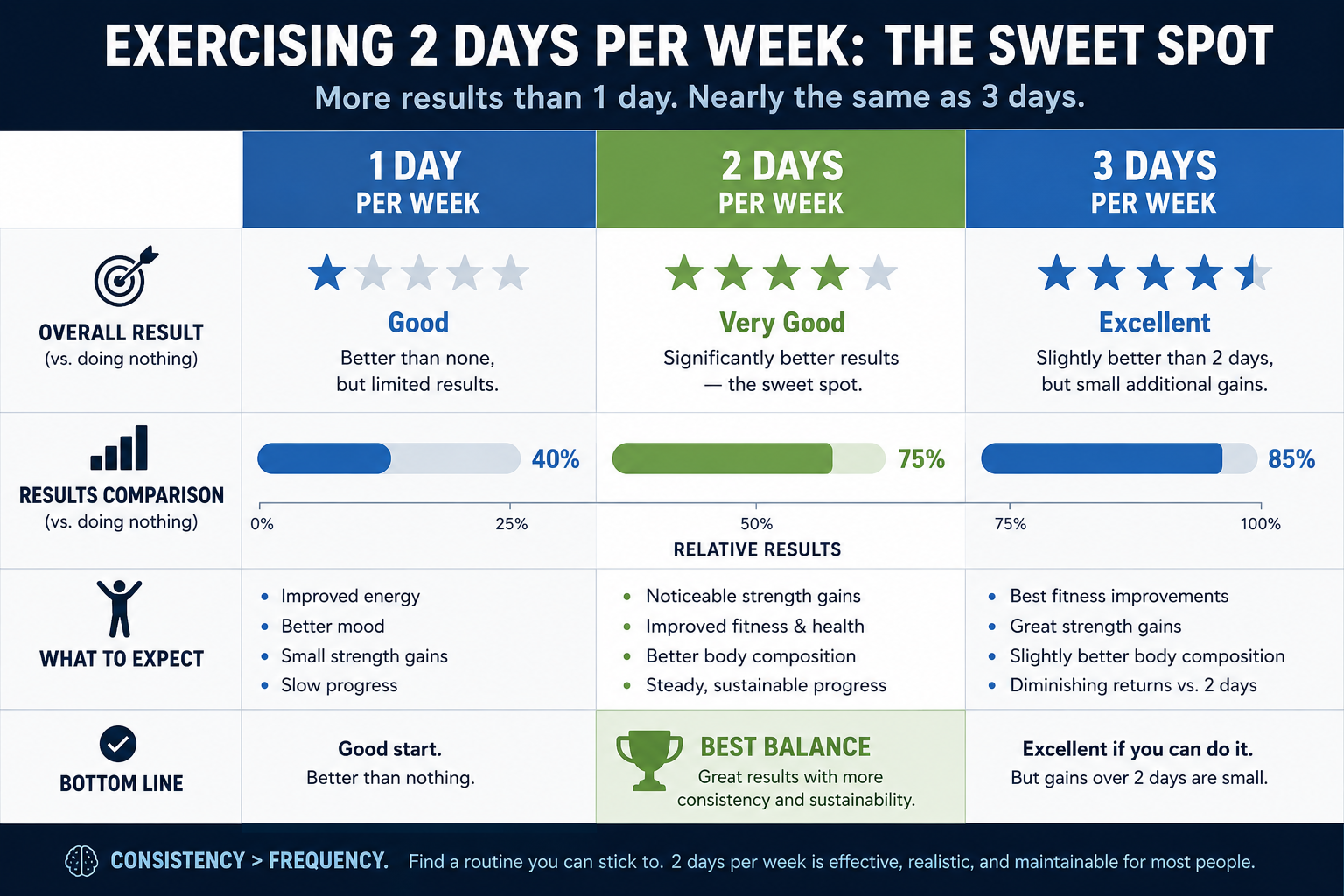
If you're brand new to exercise, start at two days a week. If you can commit to three, even better. That's the range — and after ten-plus years of coaching this age group, I don't push people past it.
Here's why:
- Two sessions a week is enough to preserve muscle mass and reduce body fat. You don't need more than that to see real change.
- Three sessions a week gets you a little more — slightly better results than two — but the jump from two to three is a smaller gain than people expect.
- Four or five sessions a week, especially right out of the gate, is where things start working against you. After 50, your tendons, muscles, and ligaments don't bounce back the way they did in your 20s, 30s, or even 40s. Soreness from a hard session typically peaks in the 48–72 hour window — which means a body that's still recovering from Monday doesn't need another hard session on Wednesday. Push past that recovery window too often and you're not building strength faster, you're building toward overtraining, injury, and burnout.
That last one is the real risk. Not the workout itself, the dropout that follows it. I'd rather have someone training consistently at three days a week for years than chasing five days a week for six weeks before they quit.
Why We Train Full Body, Not Body-Part Splits
A lot of people walk through our doors with a mental model left over from their 20s and 30s: chest day, back day, leg day — the classic bodybuilding split. That structure assumes you're in the gym five, six, even seven days a week, sometimes for 90 minutes at a time.
That's not what your body needs at this stage, and honestly, it's not what your life has room for anymore.
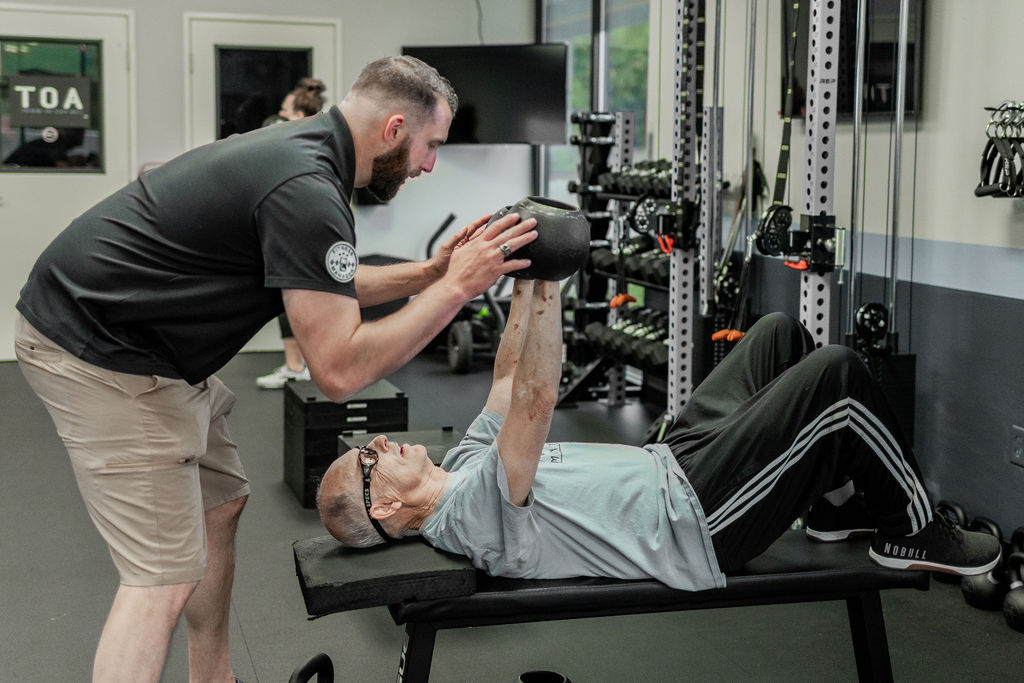
At STRONG, every session is full body — and that's intentional. At 50+, the goal isn't to look a certain way in the mirror (although that's a nice side effect). The goal is to keep doing the things you actually want to do: get up off the floor without thinking about it, carry your own groceries, keep up with your kids and grandkids, travel without your body holding you back. We call that "active independence." The movements that protect it are the same handful every time: pushing, pulling, carrying, hinging, split stance (lunges/step ups), reaching overhead.
A full-body workout hits all of that in one session. Three sessions a week, done right, covers everything a six-day split would — without asking you to reorganize your entire week around the gym.
The research backs this up too: 150 minutes a week is the commonly cited resistance-training target for this age group, and three 45-minute full-body sessions a week lands you right in that range — without exercise eating your whole life.
A Real Example: Mark
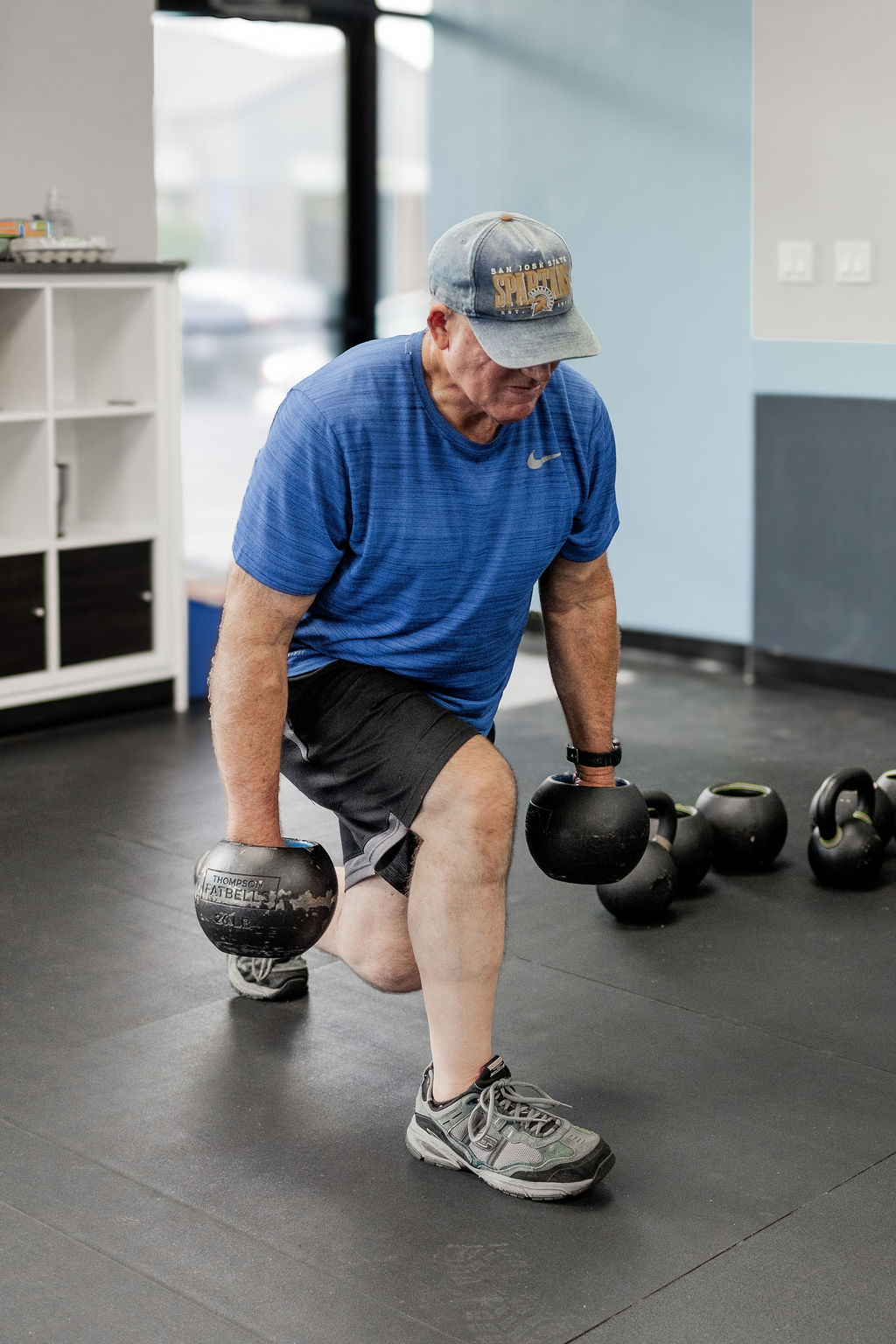
We just had a new member, Mark, start with us last month — three days a week, full body. He was genuinely surprised by two things: how sore he got from sessions that short, and how quickly he started feeling more capable outside the gym. He's not trying to build a six-pack. He wants to keep up with his friends and family without his body being the limiting factor. Three days a week, 45 minutes a session, is getting him there — and it's not consuming his life to do it.
That's the whole point. Exercise is supposed to supplement your life in your 50s, 60s, and 70s — not become it.
The Two Myths I Talk People Out of Constantly
After ten-plus years of coaching adults 50+, I see the same two mistakes over and over, and they sit at opposite ends of the spectrum.
Myth #1: "I need to train like I'm 25 again." There's nothing wrong with wanting your 25-year-old strength and energy back. But your body has thirty-plus years of life on it that your 25-year-old self didn't have. Chasing that old standard too hard, too fast almost always backfires — physically and mentally — and it's the fastest route to the overtraining problem above.
Myth #2: "I'm in pain, so I should stop moving." This is the opposite trap. Someone gets hurt — maybe from an inexperienced trainer, maybe from a weekend activity gone wrong, maybe just from life — and the fear of re-injury convinces them to do nothing. So they stay sedentary, reach for pain medication, and avoid the very exercises that would actually help them move out of pain. Avoidance doesn't fix the problem. It just guarantees the decline continues.
The two- to three-day full-body approach is built to avoid both traps: enough to make real progress, not so much that you break down or burn out.
Does Training Need to Change as You Get Stronger?
Not really — and this surprises people. After a year of consistent training, I don't bump most members up to four or five days a week. Three stays the sweet spot. More resistance training can help in theory, but in practice it starts feeling redundant for this population. What changes isn't the frequency — it's the load. We progressively increase what you're lifting within those three sessions so you keep getting stronger (or at minimum, stay strong) well into your 60s, 70s, and 80s, without needing to add more days.
What About Walking, Golf, and Everything Else?
Two to three strength sessions a week is the answer to "how many times should I work out" — but it's not the whole picture, and it's not meant to be the only movement in your week.
Personally, my own training mirrors exactly what I coach: three days of strength training a week, plus weighted walking on the weekend with about 10% of my body weight, for around an hour when I can fit it in. If I can't get that in, I'll still take my daughter and our dogs out for a walk. It doesn't have to be structured. You can do bike rides, gardening, paddle boarding, walks with the grandkids, the occasional round of golf. Whatever gets you up and moving counts. The goal is simple: stay upright, stay active, stay engaged with the things you enjoy. Strength training is the foundation — everything else is just life, lived actively instead of sedentarily.
So, How Many Times a Week Should You Work Out After 50?
Two to three times a week, full body, 45 minutes a session — built around movements that translate directly to your real life, not just the mirror. Add in whatever activity you genuinely enjoy on the side. That's it. That's the program that's worked for our members, and it's the same one I use myself.
If you're in the Folsom or Shingle Springs area and want a program built around exactly this — full-body, twice-or-three-times-a-week training designed specifically for adults 50 and up — that's what we do at STRONG, every day. [Come train with us.]
Frequently Asked Questions
Is two days a week of strength training really enough after 50? Yes. Research and our own member results consistently show two sessions a week is enough to preserve muscle mass and reduce body fat. Three sessions adds a modest additional benefit, but two is a legitimate, sustainable starting point.
Will I lose progress if I only work out twice a week? No. For most adults over 50, two full-body sessions a week is enough to maintain and build strength — especially when each session is well-structured and appropriately challenging.
Is it bad to work out every day after 50? It can be. Without enough recovery time, daily training increases your risk of overuse injury, especially since tendons, muscles, and ligaments recover more slowly after 50. Two to three well-structured sessions a week typically outperform five or six unstructured ones.
What's the best type of workout for someone over 50? Full-body strength training that mirrors real-life movement — pushing, pulling, carrying, split stance, hinging, and reaching — rather than isolated body-part splits.